opinionAIstreamingroyalties
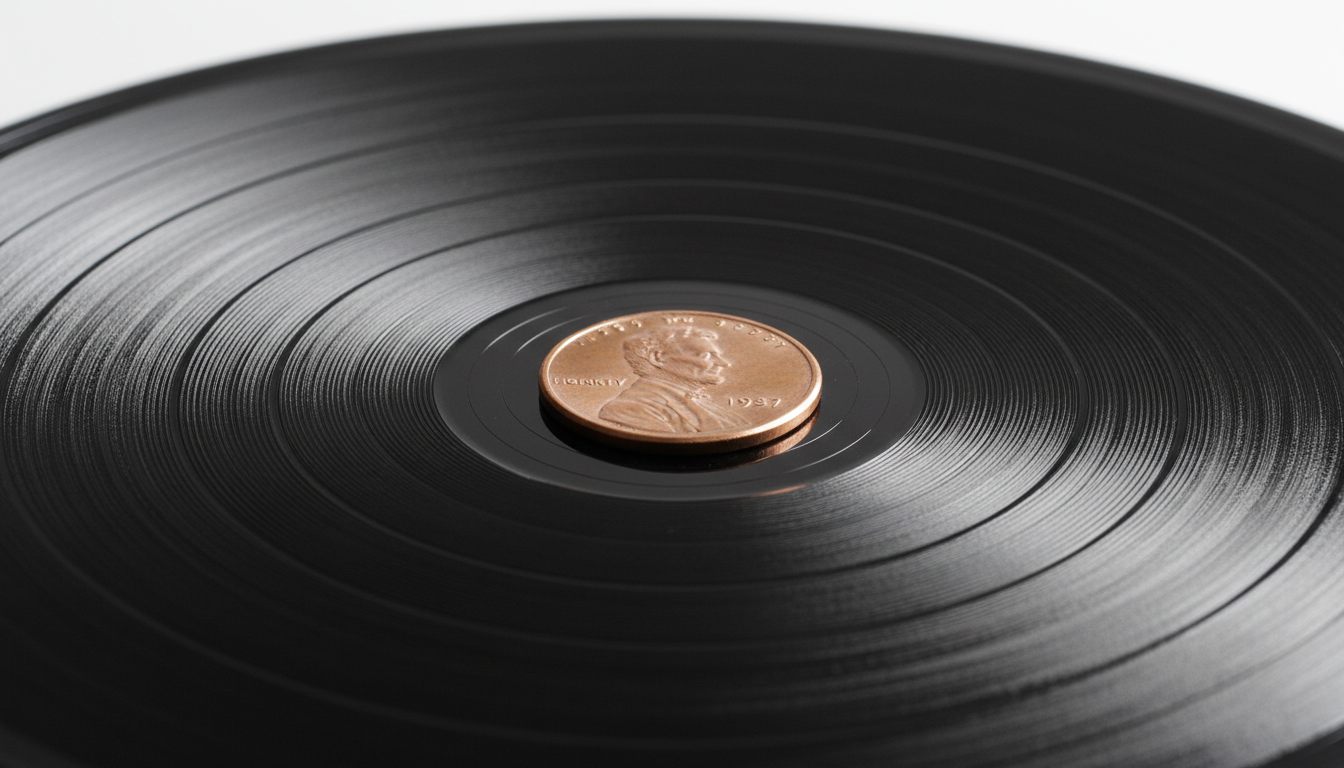
Your Song Needs 1,000 Streams to Earn a Penny. AI Uploads 60,000 Tracks a Day. Do the Math.
Spotify's royalty threshold keeps rising. AI uploads keep flooding. The math isn't complicated — it's devastating. We ran the numbers.
 Editor
March 15, 2026
6 min read
Here's the math. It's not complicated.
Spotify pays between $0.003 and $0.005 per stream. To earn $1, you need roughly 250 plays. To earn minimum wage for one hour of work at $7.25, you need about 1,800 streams. To earn $20,000 a year — below the poverty line — you need 5 million annual streams.
Five million. For poverty wages.
Now add this: as of 2026, Spotify requires a minimum of 1,000 annual streams before a track generates any royalties at all. Zero streams below the threshold means zero dollars. Not low dollars. Zero.
Over half of all songs on Spotify don't hit that threshold.
Now add this: 60,000 AI-generated tracks are uploaded to streaming platforms every single day. That's 39% of all new music delivered in January 2026. Every one of those tracks competes for the same finite pool of listener attention and the same finite royalty pool.
The math isn't complicated. It's arithmetic. And the answer is: small artists are being eliminated.
The Squeeze
Picture the royalty pool as a pie. It doesn't grow proportionally with the number of songs — it grows with the number of paying subscribers and ad revenue. Spotify had 252 million premium subscribers as of late 2025. Revenue grows slowly. Single-digit percentages per year.
Now picture the number of tracks competing for slices of that pie. There are 253 million songs on streaming platforms. A quarter of a billion. The number grows by over 100,000 per day.
More songs. Same pie. Thinner slices.
For established artists with millions of followers, this doesn't matter. Taylor Swift's per-stream revenue isn't affected by 60,000 AI uploads. Her audience seeks her out. Her streams are intentional.
For an independent artist with 500 monthly listeners — the person who quit their day job two years ago, who spent $8,000 on their debut album, who's trying to build an audience one playlist add at a time — every AI-generated track that lands on an algorithmic playlist is a competitor that didn't exist six months ago and cost nothing to create.
That independent artist doesn't need to lose streams directly to AI. They just need the pool to get diluted enough that their 900 annual streams on a given track — 900 real, human, intentional listens — fall below the threshold.
900 streams. Zero royalties. Because the bar is 1,000, and the bar exists because the system is drowning in content.
Who Set the Threshold?
Spotify introduced the 1,000-stream minimum as a quality filter. The logic: tracks below 1,000 streams were generating pennies — fractions of pennies — that cost more to process than they were worth. By redirecting those micro-payments back into the pool, the remaining artists get slightly larger slices.
This logic is correct, as far as it goes. But it was designed for a world where low-stream tracks were mostly dormant back-catalogs and hobbyist uploads. Not for a world where an AI content farm can upload 50 tracks per month, each targeting different algorithmic niches, and collectively clear the threshold through volume while individual human artists can't.
The threshold doesn't distinguish between a song with 900 genuine listeners and a song with 900 bot-generated plays. It doesn't account for intent. It doesn't ask whether those 900 streams represent real human engagement with art that matters to someone. It just counts.
And counting, in a system flooded with AI-generated content, systematically disadvantages the people who create music slowly, carefully, and for small audiences.
The Bot Problem
Deezer's numbers are damning: 85% of streams generated by fully AI-generated tracks on their platform were fraudulent. Bots. Automated plays designed to trigger royalty payments.
Think about what that means for the royalty pool. If a significant percentage of AI-generated music is being streamed by bots, those bot-generated streams are extracting real money from a pool funded by real subscriber payments. Your $10.99/month Spotify subscription is partially funding bot plays of AI-generated content that no human ever chose to hear.
Spotify says it removed 75 million spammy tracks in 2025. But removal is reactive. By the time a track is flagged, investigated, and pulled, the bot streams have already been counted and the royalties already allocated. It's whack-a-mole at industrial scale.
Deezer's approach is different: detect AI-generated content proactively, demonetize it, and exclude it from the royalty pool. They've identified 13.4 million AI tracks and sell their detection technology to other platforms.
Spotify hasn't adopted automated detection. Apple just launched voluntary tags. The two largest music streaming platforms in the world are still operating on an honor system in an ecosystem where honor is not incentivized.
What the Numbers Mean for AI Artists
Here's the twist: the royalty squeeze doesn't just hurt human artists. It hurts legitimate AI artists too.
The creators on AiMCharts who are transparent about their process, who release thoughtfully, who build genuine audiences — they're competing in the same polluted pool. When the public narrative becomes "AI music = streaming fraud," every AI artist gets painted with the same brush. When platforms crack down, the dragnet catches the careful and the careless alike.
Our chart data shows this in real time. Community-rated AI tracks with strong engagement scores — songs people genuinely listen to and return to — generate per-stream revenue at the same rate as anyone else. But their discovery is suppressed by the sheer volume of AI content that exists purely to game the system.
The 305 high-output accounts we track upload 8+ releases per month each. That's roughly 2,500 new tracks per month from a tiny fraction of AI creators. Each track is a competitor in the algorithm. Each track is noise in the signal.
The Question
The streaming economy was already broken before AI. Artists were already underpaid. The royalty model was already unsustainable for anyone outside the top 1%. AI didn't create this problem.
But AI accelerated it past the point of viability for the long tail. When 60,000 new tracks per day compete for a pool that grows at 5% annually, the math converges on a simple outcome: fewer artists can survive on streaming revenue alone.
That's not a prediction. It's already happening.
1,000 streams to earn your first penny. 60,000 AI tracks uploaded today. 253 million songs on the platform. One royalty pool.
The math is not complicated. The implications are.


