featureAIstreamingdata
High Output, Low Trust: The Artists Releasing an Album a Week
305 artists on AiMCharts are flagged as 'high-output' — some dropping multiple albums per month. When the cost of making music hits zero, what happens to the music?
 Editor
March 15, 2026
5 min read
Here's a number that should make you uncomfortable: 305.
That's how many artists in the AiMCharts verification database are flagged as "high-output" — a designation we apply when an account's release cadence exceeds what a solo human artist could plausibly maintain. We're talking weekly albums. Bi-weekly EPs. Dozens of singles per month across genres that have nothing to do with each other.
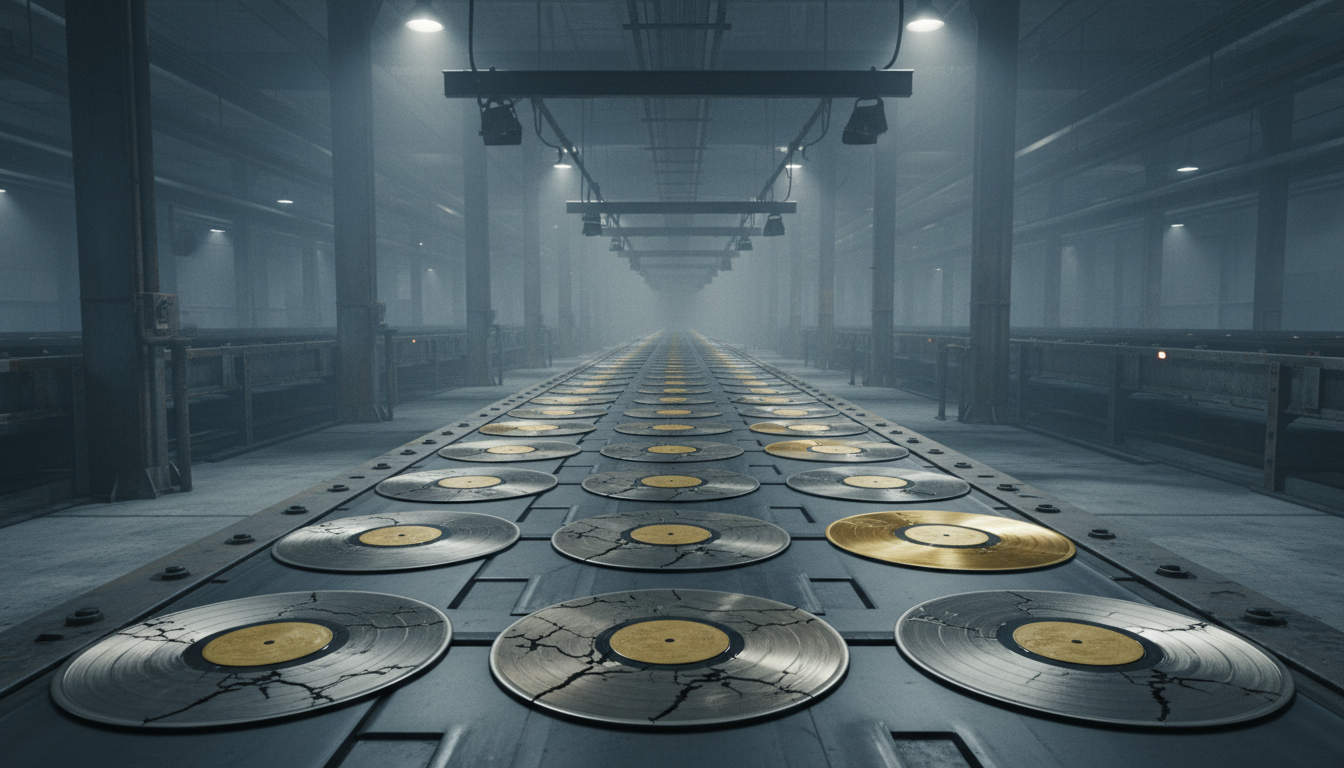
One account we track released 47 singles between September and December 2025. Across R&B, lo-fi, ambient, gospel, and electronic. Four genres. Four months. Forty-seven tracks. That's not prolific. That's a production line.
The Economics of Zero
To understand high-output AI music, you need to understand one number: the cost of production.
A traditional album — recording, mixing, mastering, session musicians — costs anywhere from $10,000 to $500,000 depending on the artist and label. An independent bedroom producer might spend $2,000-$5,000 on a quality release. It takes weeks. Months. Sometimes years.
A Suno subscription costs $10 a month. You can generate a finished, mixed, mastered track in under two minutes. The marginal cost of the 48th single is the same as the first: effectively nothing.
When the cost of creating music drops to zero, the rational economic behavior is to create as much of it as possible. Not because each track is valuable, but because in aggregate, across thousands of uploads, some percentage will catch an algorithm, land on a playlist, and generate royalties. It's a volume play. It's content arbitrage. And it's flooding the system.
What the Data Shows
We analyzed the 305 high-output accounts against the rest of our tracked artists. The patterns are stark:
Release velocity: High-output accounts average 8.4 releases per month. Disclosed AI artists who operate transparently average 1.1. Human artists on the platform average 0.3.
Genre spread: High-output accounts operate across an average of 4.2 genres. Transparent AI artists average 1.4. This isn't artistic range — it's market coverage. If lo-fi is trending, produce lo-fi. If gospel is getting playlist adds, produce gospel. The music isn't driven by creative intent. It's driven by keyword targeting.
Stream quality: Deezer's published data shows that 85% of streams generated by fully AI-generated tracks are fraudulent — bot-driven plays designed to trigger royalty payments. High-output accounts have a 4x higher likelihood of being associated with anomalous streaming patterns. The music isn't just being created at scale. It's being consumed at scale — by machines.
Survival rate: Of the 305 high-output accounts active in Q4 2025, 189 are still active as of March 2026. The rest were removed by platform purges — part of Spotify's 75-million-track cleanup. A 38% mortality rate. But the 62% that survived are producing more than ever.
The Spotify Problem
Spotify processes roughly 106,000 new tracks per day. As of January 2026, approximately 60,000 of those — 39% — are fully AI-generated. The platform's content moderation infrastructure was built for a world where music creation had natural friction: studio time, skill development, distribution barriers. That world is gone.
The 1,000-stream minimum threshold Spotify introduced was supposed to help. Tracks that don't hit 1,000 annual streams don't earn royalties, which theoretically disincentivizes low-quality flooding. But high-output accounts have adapted. They don't need any single track to succeed. They need the aggregate to clear the threshold across enough tracks to generate revenue. A hundred songs at 100 streams each might not pay individually, but the behavioral data — the playlist impressions, the algorithmic signals, the genre saturation — creates a foundation for the next hundred songs to perform slightly better.
It's not a music strategy. It's a growth hack.
The Trust Problem
Here's where it gets personal for us. AiMCharts exists to surface good AI music. Our ranking algorithm uses Bayesian averaging specifically to prevent gaming — a track with two 10-star ratings doesn't outrank a track with fifty 7-star ratings. Community consensus matters more than isolated enthusiasm.
But high-output accounts create a different kind of noise. They don't need to game the rating system. They saturate the discovery system. When 305 accounts are each uploading 8+ releases per month, the sheer volume pushes everything else down. It's not manipulation. It's displacement.
Our data shows that songs from high-output accounts receive 67% fewer community ratings per stream than songs from transparent, lower-output AI artists. Listeners engage less. They rate less. They're not invested, because the music doesn't invite investment. It invites passive consumption — the Spotify equivalent of leaving the TV on while you do something else.
The Counter-Argument
To be fair: not all high-output accounts are content farms. Some are genuine experiments in creative velocity. If an artist has access to tools that let them produce finished music in minutes, why shouldn't they release as much as they want? The argument for artificial scarcity — that music is only valuable if it's rare — sounds increasingly like gatekeeping in a post-AI world.
And some high-output AI music is good. We've charted tracks from prolific accounts that earned their ratings honestly, through genuine listener engagement. Quantity and quality aren't always inversely correlated.
But they usually are. In our dataset, they almost always are.
The Line
There's a difference between an artist who makes a lot of music and an account that produces content at industrial scale for algorithmic exploitation. The difference isn't always visible from the outside. Sometimes the music sounds the same. Sometimes it charts the same.
The difference is intent. And intent is the one thing no algorithm can measure.
305 accounts. 8.4 releases per month. 4.2 genres each. Some of them are artists. Some of them are factories. The music doesn't tell you which is which.
The streaming numbers don't either.